VS Code Extension
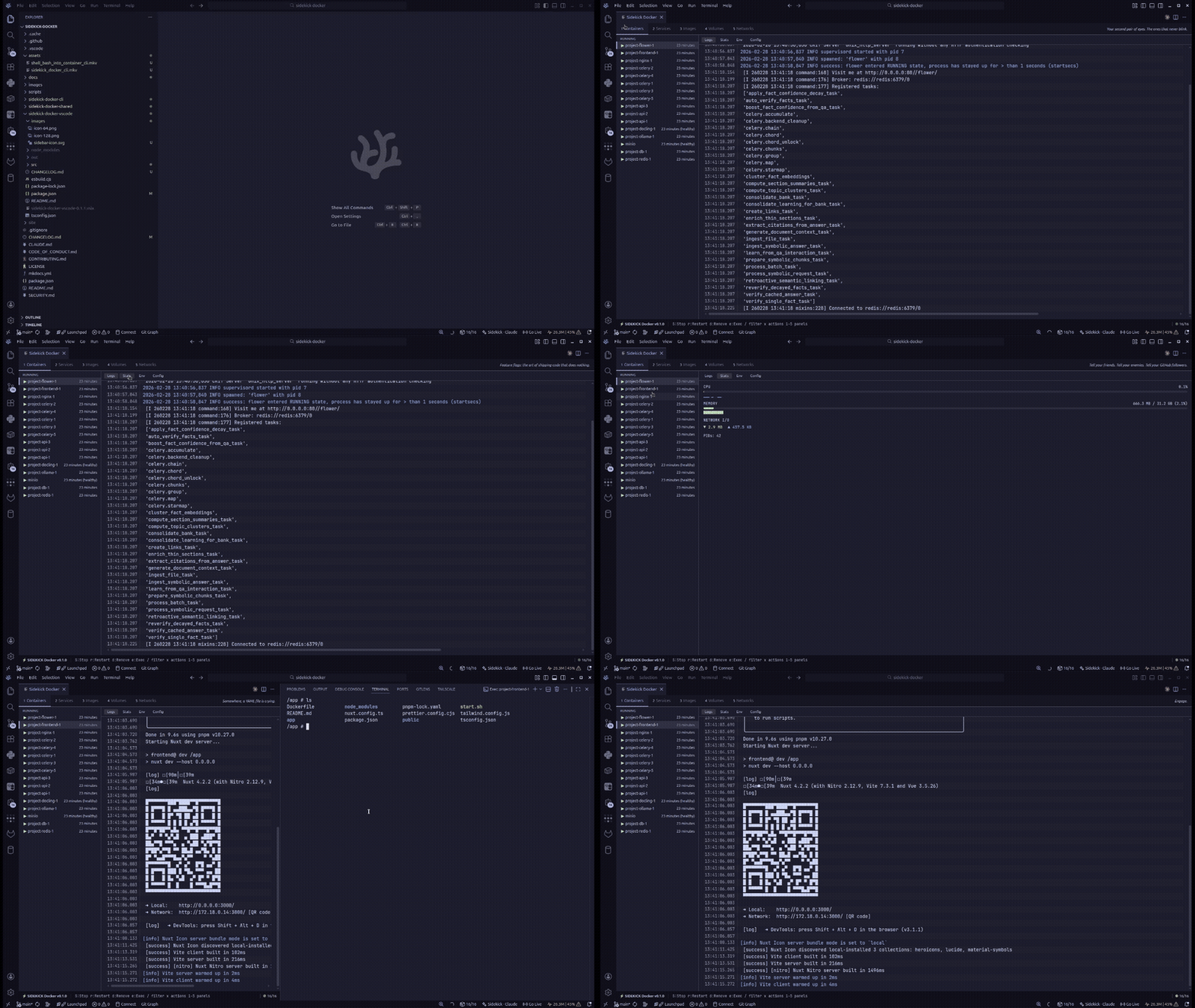
The Sidekick Docker extension embeds the Docker dashboard as a webview panel inside your editor. Works with VS Code, VSCodium, and compatible editors.
Installation
Install from Open VSX (recommended for VSCodium and compatible editors) or the VS Code Marketplace. You can also search for Sidekick Docker in the Extensions view.
Opening the Dashboard
Open the command palette (Ctrl+Shift+P / Cmd+Shift+P) and run:
or press Ctrl+Alt+D — Ctrl, not Cmd, on macOS too (macOS reserves Cmd+Opt+D for the Dock). The dashboard opens as a webview panel with the same layout as the terminal TUI. The dashboard panel survives window reloads.
Commands
| Command | Description |
|---|---|
Sidekick Docker: Open Dashboard |
Open the dashboard (Ctrl+Alt+D, all platforms) |
Sidekick Docker: Open Dashboard to the Side |
Open in a split editor column |
Sidekick Docker: Refresh Containers |
Refresh the tree view (Ctrl+Alt+R / Cmd+Alt+R when the Containers view is focused) |
Sidekick Docker: Start/Stop/Restart Container... |
Quick-pick a container to act on |
Sidekick Docker: Exec into Container... |
Quick-pick a running container and open a terminal inside it, using sidekick-docker.exec.defaultShell |
Sidekick Docker: Show Container Logs... |
Quick-pick a container and open the dashboard on its logs |
Containers Tree View
The activity-bar Containers view groups containers by state (and by Compose project), with start/stop/restart/pause/unpause/remove and "Open in Dashboard" in the context menu. A status-bar item shows running/total counts and opens the dashboard on click. When the Docker daemon is unreachable, the view offers a Retry Connection action.
Settings
| Setting | Default | Description |
|---|---|---|
sidekick-docker.socketPath |
"" |
Docker endpoint: socket path, unix://, or tcp://host[:port]. Empty uses the platform default (or DOCKER_HOST). |
sidekick-docker.refreshIntervalSeconds |
30 |
Fallback full-refresh interval in seconds (minimum 5). |
sidekick-docker.statusBar.visible |
true |
Show the status-bar container counts. |
sidekick-docker.exec.defaultShell |
/bin/sh |
Shell used when opening an exec terminal into a container. |
Settings apply immediately — the extension reconnects without a window reload.
Features
- Full Docker dashboard — containers, Compose, images, volumes, networks
- Real-time updates — logs and stats stream live inside the editor
- Smart log highlighting — token-level syntax coloring for HTTP methods, status codes, URLs, IPs, timestamps, JSON keys, and more
- Log search & filter — search within log output with exact or fuzzy matching and match highlighting
- Log analytics — severity count badges and pattern clustering that groups similar logs into templates
- Container management — start, stop, restart, pause, unpause, remove directly
- Health status — shows healthy/unhealthy/starting indicators for containers with health checks
- Compose support — detect and manage projects
- Stats monitoring — live CPU, memory, network I/O, and block I/O metrics with sparkline charts
- Filesystem inspector — view all filesystem changes inside containers (Files tab)
- Image layer explorer — inspect image layer history with sizes and Dockerfile instructions (Layers tab)
Requirements
- VS Code >= 1.109
- Docker running and accessible
Architecture
The extension uses a webview panel to render the dashboard. The extension host (Node.js) communicates with the webview (browser) via postMessage() with a typed message protocol.
Key files:
| File | Role |
|---|---|
src/extension.ts |
Activation, command registration |
src/providers/DockerDashboardProvider.ts |
Webview lifecycle, Docker API bridge |
out/webview/dashboard.js |
Dashboard UI (browser context) |
src/types/messages.ts |
Typed request/response messages |
See Architecture Overview for more details.